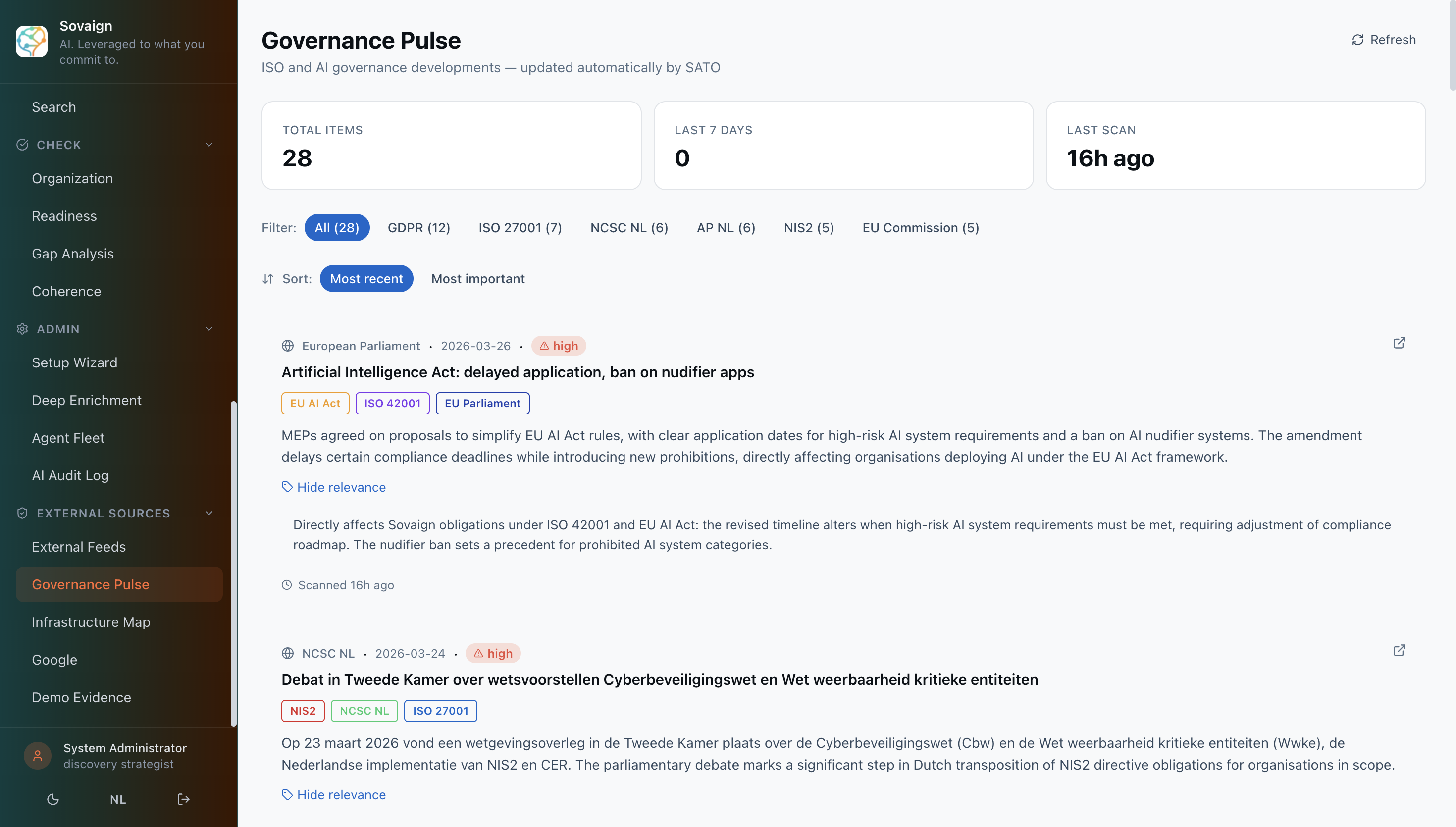
This was a busy week for organisations trying to keep pace with European digital regulation. Three developments stood out — and all three landed in Sovaign's scheduled Governance Pulse, without anyone having to read a single RSS feed manually.
What happened
The EU AI Act gets a revised timeline. On 26 March, the European Parliament agreed on amendments that delay certain high-risk AI system requirements while introducing an outright ban on AI nudifier applications. For organisations already mapping their AI systems against ISO 42001 and the EU AI Act, this changes the compliance roadmap: some deadlines shift later, but the prohibited-system categories just expanded (in this case, a good idea). The amendment passed with broad support, suggesting it will move quickly through the remaining legislative steps.
The Dutch Cyberbeveiligingswet moved through parliament. On 23 March, the Tweede Kamer debated the Cyberbeveiligingswet (Cbw) and the Wet weerbaarheid kritieke entiteiten (Wwke) — the Netherlands' transposition of the EU NIS2 directive and the Critical Entities Resilience Directive (CER). This is the legislation that will impose mandatory cybersecurity risk management and incident reporting requirements on a wide range of organisations, including IT service providers and digital service providers. If your organisation already operates under ISO 27001, much of the control framework translates directly — but the reporting obligations and supervisory scope are new.
The European Commission's own infrastructure was attacked. On 24 March, a cyber-attack hit the Commission's Europa.eu cloud platform. CERT-EU activated incident response. The irony is hard to miss: the institution drafting NIS2 incident reporting rules had to follow them itself. For the rest of us, it is a concrete reminder that cloud infrastructure — even at institutional scale — is a target, and that incident response controls under ISO 27001 Annex A.16 are not theoretical.
How Sovaign found this
To be honest — these items were already flagged by a human reading news feeds — but that's our core business. Still useful though: Sovaign's autonomous agent system — SATO — runs a periodic governance news scan that fetches RSS feeds from eight institutional sources (relevant to our location): NIST, the Dutch NCSC, Autoriteit Persoonsgegevens, EDPB, the European Commission (both its digital strategy and press feeds), and the European Parliament. It also queries the Dutch Officiële Bekendmakingen API for new legislation in five topic clusters.
For each feed, SATO parses the items, filters for relevance to the frameworks in scope (ISO 27001, ISO 42001, EU AI Act, NIS2, GDPR), assigns a confidence score, and persists the results directly into the knowledge graph. The Governance Pulse screen — shown above — surfaces these items with framework tags, relevance scores, and direct links to the source publications.
The whole process takes about ten minutes and produces a structured, queryable record of what changed in the regulatory landscape. No inbox to check. No analyst to brief. The information arrives pre-tagged, pre-scored, and already linked to the frameworks your obligations live under.
Why this matters for compliance teams
Regulatory monitoring is one of those obligations that every standard requires and nobody enjoys. ISO 27001 clause 4.1 asks you to identify external issues relevant to your ISMS. ISO 42001 clause 4.1 asks the same for your AI management system. In practice, this means someone has to read regulatory news, decide what applies, and feed the conclusions back into the risk assessment.
Most organisations solve this with a quarterly review meeting where someone summarises what they remember reading. The gap between “the regulation changed” and “our compliance programme reflects the change” is typically measured in weeks or months.
Sovaign closes that gap to hours. The governance news scan runs automatically. The items are immediately queryable alongside your obligations, controls, and evidence. When a regulatory change is relevant to an obligation you already track, the system can surface it in context — not in a separate news feed, but in the same graph where your compliance reasoning lives.
This is not about replacing human judgement. The approval and activation of compliance paths remains a deliberate, human-in-the-loop decision. But the discovery — the part where you notice that something changed — should not depend on someone's reading habits.
Sovaign is a self-hosted compliance knowledge platform. The Governance Pulse feature is available to all users with a deployed instance. If you want to see how it works with your own frameworks, visit sovaign.com.